Serial 2 S Complementer Shift Register
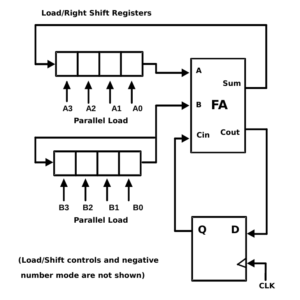
Design a 2's complementer with a shift register and a flip-flop. The binary # is shifted out from one side and it's 2's complement shifted into the other side of the shift register. Design a serial 2's complementer using a shift register, a single DFF and minimum number of other gates. The binary number is shifted out from one side.
Hey guys, so the question reads: It is known that the 2's complement of a binary number can be formed by leaving all significant 0's and the first 1 unchanged and complementing all other higher bits. Design a serial 2's complementer using this procedure. The circuit needs a shift register to store the binary number and an SR flip flop to be set when the first least significant 1 occurs.
Elegance jc 5428 manual pdf. An advanced digital machining center with intelligent 3D laser scanners ensure that accurate samples are produced for our OEM clients. Once a new product is ready for production, our QC team ensures that products are manufactured according to ISO9001 and CE standards. We have devoted considerable resources to the R&D of our products and have met with a significant number of successes. Many of our products are patented, and our designs are considered original and imaginative.
An XOR gate can be used to transfer the unchanged bits (x[xor]0=x) or complement the bits (x[xor]1=x'). So i understand all the components in the circuit, like the register, the xor gates, and the SR, but i have no idea about how to mesh them together to form this circuit Any help would be mucho appreciatedo!
Arch #11 Computer Architecture Start Lecture #11 Homework: Read 3.1-3-4 3.1: Introduction I have nothing to add. 3.2: Signed and Unsigned Numbers MIPS uses 2s complement (just like 8086) To form the 2s complement (of 0000 1111 0000 1010 0000 0000 1111 1100) • Take the 1s complement. • That is, complement each bit (1111 0000 1111 0101 1111 1111 0000 0011) • Then add 1 (1111 0000 1111 0101 1111 1111 0000 0100) Need comparisons for signed and unsigned. • For signed a leading 1 is smaller (negative) than a leading 0 • For unsigned a leading 1 is larger than a leading 0 Comments on Two's Complement You could easily ask what does this funny notation have to do with negative numbers. Let me make a few comments. • What does minus 1 mean? Ans: It is the unique number that, when added to 1, gives zero.
• The binary number 1111.1111 has this property (using regular n-bit addition and discarding the carry-out) so we do seem to have -1 correct. • Just as n+1 (for n≥0) is defined as the successor of n, -(n+1) is the number that has -n as successor.
That is we need to show that TwosComp(n+1) + 1 = TwosComp(n). • This would follow if we coud show OnesComp(n+1) + 1 = OnesComp(n), i.e, (n+1)' + 1 = n'. • Let n be even, n = *0, * arbitrary. • Write n', n+1 and (n+1)' and see that it works. • Let n be odd, n = *01 s1, where 1 s just means a bunch of ones. • Again it works. • So for example TwosComp(6)+1=TwosComp(5) and hence TwosComp(6)+6=zero, so it really is -6.

Sltu and sltiu Like slt and slti but the comparison is unsigned. Homework: 3.1-3.6 3.3: Addition and subtraction To add two (signed) numbers just add them. That is, don't treat the sign bit special. To subtract A-B, just take the 2s complement of B and add. An overflow occurs when the result of an operation cannot be represented with the available hardware. For MIPS this means when the result does not fit in a 32-bit word.
• We have 31 bits plus a sign bit. • The result would definitely fit in 33 bits (32 plus sign) • The hardware simply discards the carry out of the top (sign) bit • This is not wrong--consider -1 + -1 11 (32 ones is -1) + 11 ---------------------------------- 110 Now discard the carry out 10 this is -2 • The bottom 31 bits are always correct.
Overflow occurs when the 32 (sign) bit is set to a value and not the sign. • Here are the conditions for overflow Operation Operand A Operand B Result A+B ≥ 0 ≥ 0 64 multiplier. What about the control? • Always give the ALU the ADD operation • Always send a 1 to the multiplicand to shift left • Always send a 1 to the multiplier to shift right • Pretty boring so far but • Send a 1 to write line in product if and only if LOB multiplier is a 1 • I.e.
Send LOB to write line • I.e. It really is pretty boring This works!
But, when compared to the better solutions to come, is wasteful of resourses and hence is • slower • hotter • bigger • all these are bad An Improved Circuit The product register must be 64 bits since the product can contain 64 bits. Why is multiplicand register 64 bits?
• So that we can shift it left • I.e., for our convenience. By this I mean it is not required by the problem specification, but only by the solution method chosen. Why is ALU 64-bits? • Because the product is 64 bits • But we are only adding a 32-bit quantity to the product at any one step.